

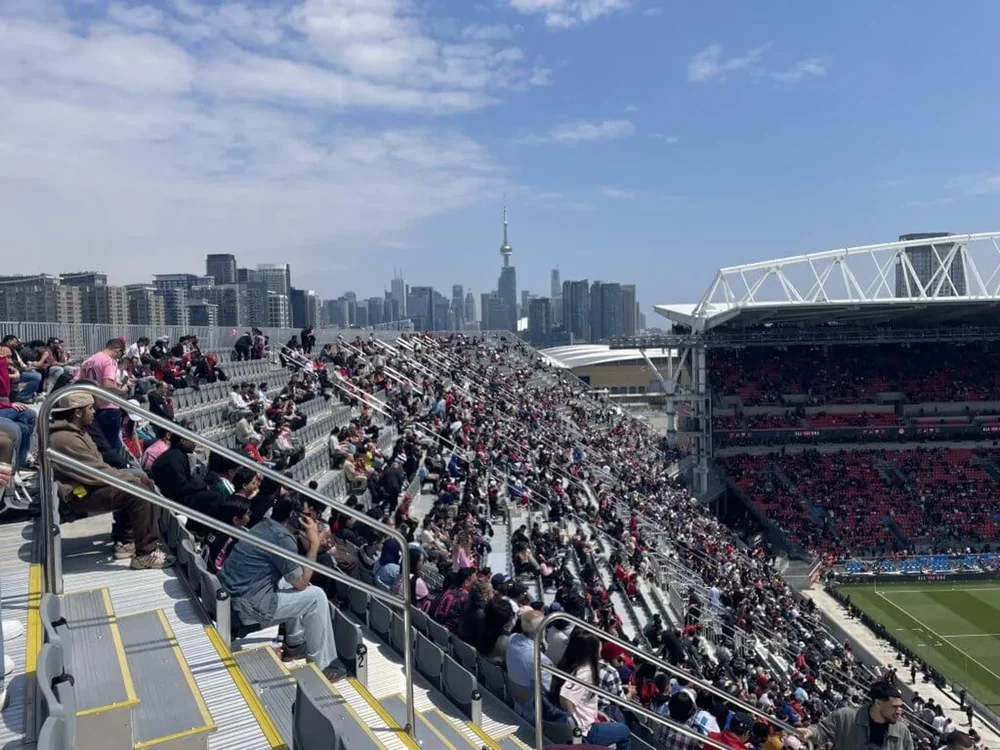
TORONTO – When Lionel Messi surged toward goal early in the first half of Saturday’s matchup between Toronto FC and Inter Miami, an unusual scene unfolded in section 228 of BMO Field. Hundreds of fans remained firmly seated.
In most other sections, every touch by the greatest player in soccer history had spectators jumping to their feet with excitement. But those in the far northwest corner of the waterfront stadium can be excused for staying still. The wind from nearby Lake Ontario had picked up, making the seats feel like they were swaying. Quickly leaping into the air on scaffolding-supported seats is not easy to overcome mentally.
“When it gets a bit windy, it feels unsafe because you feel it shaking,” Arleen Gill of Brampton, seated in the last row of section 228, told The Athletic. “But otherwise, when there’s no wind, it feels fine.”
Saturday marked the first use of section 228 and the temporary stands installed on the north side of the World Cup stadium. BMO Field’s normal MLS capacity is 28,180, but FIFA requires all World Cup venues to hold at least 40,000. To meet this standard, BMO Field added temporary stands: 10,000 on the north side and 7,000 on the south. Even with these extra 17,000 seats, BMO Field—renamed Toronto Stadium for the World Cup due to FIFA regulations—will be the smallest of the 16 World Cup venues this summer, with a capacity of 45,736.
The temporary stands evoke memories of Yekaterinburg’s Central Stadium from the 2018 World Cup, which featured unusual temporary structures built outside the main stadium.
“The seats are moving, but the stands themselves aren’t really moving that much,” said Stefano Di Matteo, who also sat in the last row of section 228.
This was the experience in Toronto as the north stand, built for the World Cup, was used for the first time. How does it feel to sit in one of the 10,000 seats supported by scaffolding that looks far less sturdy than the thousands of permanent seats? I decided to experience it by sitting in the north stand during part of the game.
The north section has 13 rows in the first block of temporary seats near field level, with two levels of hospitality suites above them. Then there are 38 additional rows of seats forming the majority of the stand.
Getting to the far end is not easy. Fans must climb multiple steep sets of temporary stairs. As I climbed to the top, I had to pause for others who needed to catch their breath. Once in the deepest part of the north stand, the wind’s impact became impossible to ignore. The stands felt like they were swaying with each gust, though nearby rails seemed still.
I checked with several fans nearby to confirm I wasn’t imagining the swaying. Their wide eyes answered affirmatively. As I stood for the American and Canadian national anthems before the game, I placed my right hand on a nearby rail. When the anthems ended, I noticed my small navy blue notebook in my left hand was wet with sweat from my palm.
The strongest gusts created a rare sensation at a soccer match: weightlessness. As fans sitting in more central areas cheered, those in the temporary stand cautiously held on.